How to Start a Business Blog Australia: The 2026 Guide
Learn how to start a business blog in Australia with our step-by-step guide on strategy, templates, and workflows to drive local leads and sales.

Starting a business blog is one of the most effective ways to grow your brand and attract local customers. It transforms your website from a static brochure into a dynamic lead-generation machine.
TL;DR (Too Long; Didn't Read):
Choose a .com.au domain and local hosting for better search performance.
Use a structured template and keep paragraphs under 2 sentences for readability.
Aim for 1-2 quality posts per month to build long-term topical authority.
But here's the thing: quick Answer
To start a business blog in Australia, you must define your niche, register a .com.au domain, and set up a CMS like WordPress. Success requires a consistent blogging workflow, starting with keyword research and ending with a clear call-to-action that converts readers into local clients.
Attribute | Detail |
|---|---|
Primary Goal | Lead Generation & SEO |
Typical Setup Cost | $150 - $500 AUD |
Best Platform | WordPress.org (Self-hosted) |
🎯 Key Takeaways
✓Industry estimates suggest businesses that blog get 55% more visitors on average.
✓ Aim for one to two high-quality posts per month for consistency.
✓Industry estimates suggest SEO results typically take 8 to 16 weeks to manifest.
✓ Mobile optimisation is vital as 50% of AU traffic is on phones.
Before You Type: Aligning Your Blog with Australian Business Goals
Now, here's where it gets interesting: successful blogging isn't about writing what you feel like on a Tuesday morning. It's about aligning your content with your bottom line and what your customers actually need.
As Wakeford Digital explains, a considered blog drives traffic and enquiries by building topical authority over time. You should decide whether your goal is brand awareness, lead generation, or customer education.
Think about it this way: every post is a long-term asset. While a social media post disappears in hours, a blog post can attract traffic for years after publication.
So what does this mean for you? in 2025, businesses should also focus on local relevance. If you serve a specific region, your topics should reflect local issues or events to capture regional search intent.
Your legal obligations are also important here in Australia. Ensure your blog includes a clear privacy policy and terms of use to comply with local regulations and build trust.
Setting the Foundations: Hosting and Domain Strategy
Your technical setup determines how well your blog performs in search results. Choosing the right platform and hosting provider is the first major hurdle for most owners.
Let's break this down further. Local web hosting is often the best choice for Australian businesses. It improves page load speeds and can potentially boost your local search result placements.
For your domain, a .com.au address identifies you as a legitimate Australian entity. This builds immediate trust with local readers and search engines alike.
The truth is, WordPress remains the industry standard for a reason. It is free to install once you have registered your domain and arranged web hosting through a provider like VentraIP Australia.
Here's the bottom line: using a subdirectory like yourdomain.com.au/blog is usually better than a subdomain. This helps consolidate your website's authority and keeps your analytics data in one manageable place.
The Essential Australian Blogging Stack
✓WordPress for content management.
✓Local AU hosting for speed.
✓Google Analytics 4 for tracking.
✓Yoast SEO or Rank Math for optimisation.
Writing for the Web: How to Structure Posts for Scanners
People read differently online than they do in a book. Most visitors will scan your headings and bullet points before deciding if the meat of the content is worth their time.

What does this mean for you? You need to keep paragraphs short—maximum two sentences each—to provide plenty of white space for mobile users.
Your headings should be descriptive and include your target keywords. This helps both the reader and search engines understand the hierarchy of your information.
Include a clear call-to-action (CTA) in every single post. Whether it's signing up for a newsletter or getting a quote, tell your reader exactly what to do next.
Writing for a mobile audience is critical because over 50% of Australian web traffic comes from mobile devices as of 2024. If your blog isn't easy to read on a phone, you will lose visitors fast.
By the way, having a mobile-responsive website is no longer optional in the Australian market. It is a fundamental requirement for SEO and user experience.
A Reusable Blog Post Template for Maximum Impact
Don't look at a blank screen and wait for inspiration to strike. Use a proven framework to get your thoughts out of your head and onto the page efficiently.
According to The Marketing Project, a professional blog post always starts with a strong, curiosity-driven headline that promises a benefit.
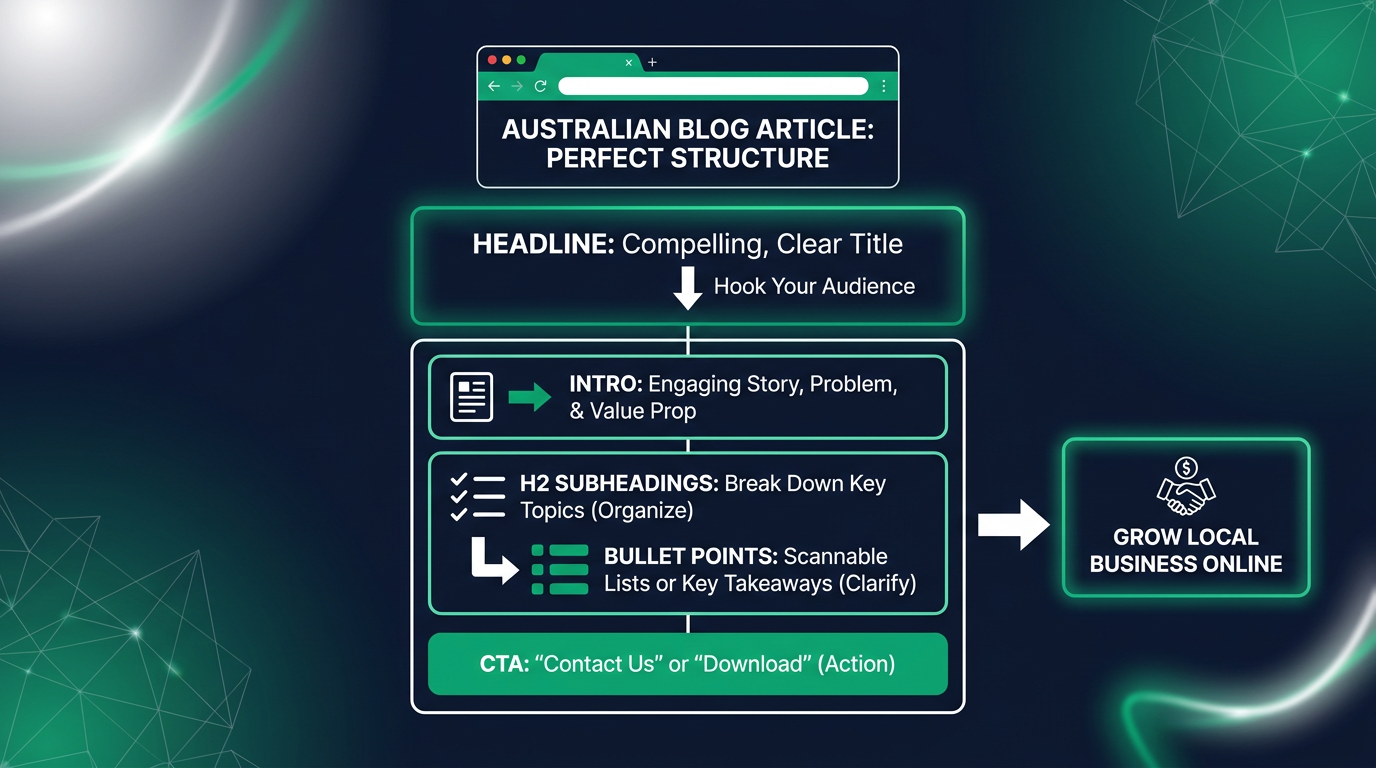
Follow this simple structure for every post:
Headline: Clear, keyword-rich, and engaging.
Introduction: Hook the reader and explain why the topic matters.
Body Content: Use H2 and H3 subheadings to break up the points.
Visuals: Use images or infographics to explain complex ideas.
Conclusion: Summarise the key takeaway and add your CTA.
The key takeaway? Consistency beats perfection.
A structured approach allows you to produce high-quality content without feeling overwhelmed by the process.
This ensures your content remains natural and helpful for human readers.
The Time-Poor Founder's Blogging Workflow
Managing a business is busy enough without adding content creator to your job title. You need a workflow that fits into your existing schedule without causing burnout.
Establish a content calendar to plan your topics at least a month in advance. This prevents the last-minute scramble to find something to write about each week.
Now, here's where it gets interesting: you only need to post once or twice a month. Maintaining a steady pace is more important for SEO than a short burst of daily activity.
Workflow Stage | Time Required | Key Tool |
|---|---|---|
Keyword Research | 30 Mins | Keywords Everywhere |
Drafting/Writing | 90 Mins | Google Docs / AI |
Optimisation | 20 Mins | Yoast SEO |
Promotion | 15 Mins | Social Media |
Schedule your writing time like any other client meeting. Consistently setting aside two hours a fortnight can generate a massive library of assets over a single year.
Industry estimates suggest don't forget to revisit your old content every 12 to 16 months. Refreshing outdated facts and links can give an old post a significant second life in the rankings.
You can also use tools like blogs for SEO to understand how your posts contribute to your overall search visibility. Tracking performance is the only way to know what is truly working.
15+ Blog Content Ideas Your Australian Customers Want
Stuck for ideas? The best topics come from the questions your customers ask you every single day through email or over the phone.
Think about the common myths in your industry. Busting these myths positions you as an honest authority and provides high value to your prospective clients.
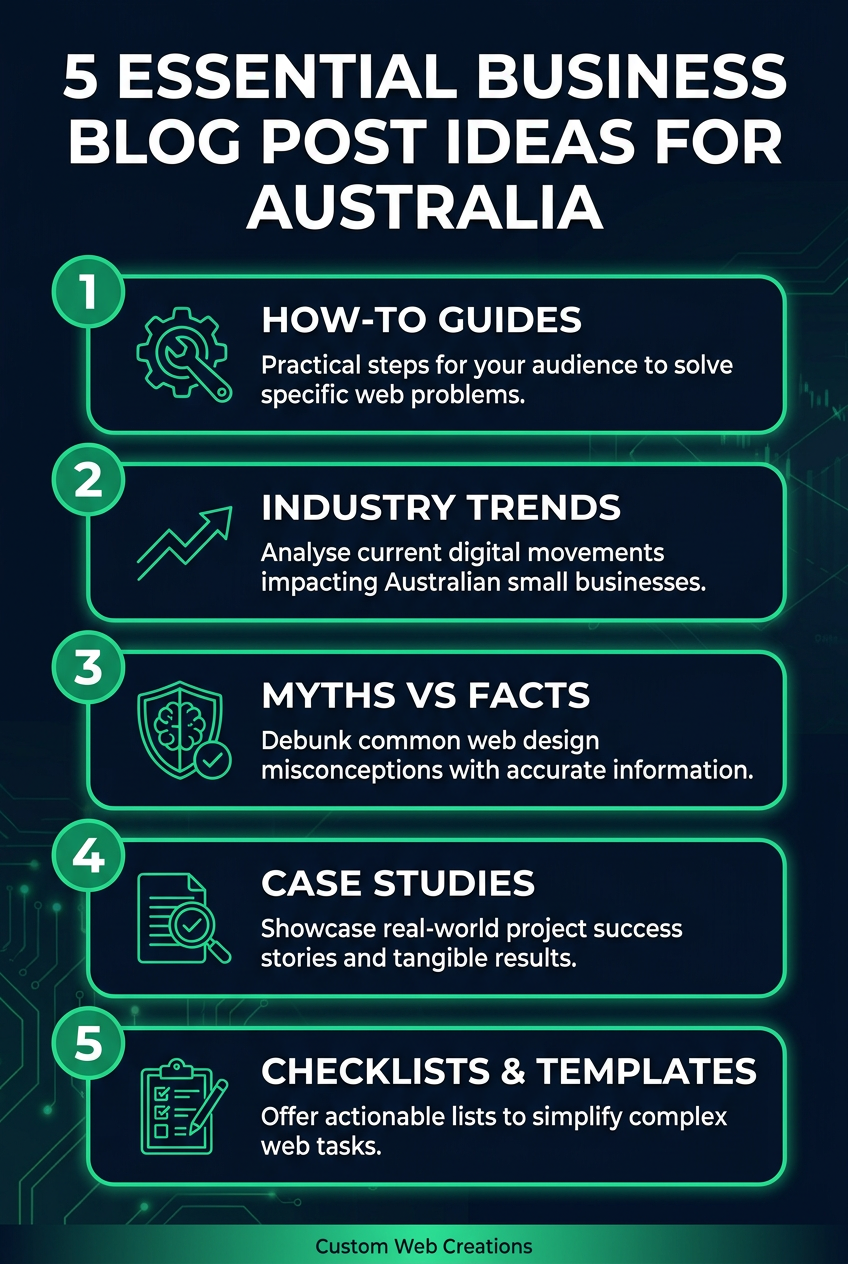
Here are several content categories that work well for local businesses:
How-to Guides: Teach your audience how to solve a specific problem.
Industry Trends: How do global changes affect local Australian customers?
Checklists: Provide a downloadable tool that helps someone prepare for a service.
Case Studies: Show how you helped a local client achieve a specific result.
Comparison Posts: Compare two products or approaches so customers can choose.
What should an Australian small business blog about? Focus on the "They Ask, You Answer" philosophy to address pain points directly through your website content.
Remember that Australian consumer behaviour is unique. Use local terminology and reference local regulations, such as the Australian Consumer Law, to resonate with your readers.
Meeting Your Legal and Ethical Obligations
Blogging for business comes with responsibilities, especially under the Australian regulatory landscape. Transparency is king when building a professional online presence.
If you include affiliate links or sponsored content, you must disclose this clearly. Failing to do so can violate ACCC guidelines regarding misleading and deceptive conduct.
Privacy is another major consideration. Ensure your site has a clear privacy policy, especially if you are using tracking tools like Google Analytics 4 to monitor visitor behaviour.
So what does this mean for you? It means you shouldn't cut corners on the legal pages of your website.
These pages build trust with both your readers and search engines like Google.
You can find more information about compliant website setups in our guide on Google Business Profile setup. This ensures your entire digital footprint is cohesive and professional.
Measuring Success: KPIs for Your Blog
How do you know if your blogging efforts are paying off? You need to look beyond vanity metrics like total page views and focus on business outcomes.
Google Search Console is a free and essential tool for tracking yours keywords. It shows you exactly what people are typing into Google to find your blog posts.
Here's the bottom line: your primary goal should be conversions. This might be a lead form submission, a phone call, or a newsletter sign-up from your blog readers.
In 2025, you should expect it to take 8 to 16 weeks to see meaningful movement for new posts. SEO is a marathon, not a sprint, so patience is required during the initial phase.
Monitor your bounce rate and time on page to see if readers find your content engaging. High engagement tells Google that your content is high-quality and deserves a higher rank.
If you need expert help scaling your content, considering a partner for SEO in Brisbane can provide the technical edge needed to beat national competitors.
Frequently Asked Questions
Further Reading
Why Is a Blog Important for SEO? A 2026 Guide
A deep dive into how blogging directly impacts your rankings in Australia.
ACCC Advertising & Selling Guide
Essential legal reading for Australian business owners publishing online content.
WordPress Settings for SEO
A technical walkthrough for setting up your blog directory correctly.
Ready to Start Your Project?
Let's discuss how we can help bring your vision to life with our expert web design and development services.
Get a Free QuoteRelated Articles

Why Is a Blog Important for SEO? A 2026 Guide for Australia
Discover how blogging for SEO drives traffic and authority. Learn the content marketing benefits that help Australian businesses dominate rankings.

SEO Brisbane: Your Guide to Ranking #1 Locally in 2026
Is your Brisbane business invisible online? Our guide to SEO in Brisbane covers everything from local rankings and Google Maps to costs and strategies.

How to Build Brand Authority Online in Australia (2026)
Learn how to build brand authority online in Australia. Our guide covers E-E-A-T, Digital PR, off-page SEO, and trust signals to boost your credibility.

Do Social Media Profiles Affect SEO in Australia? (2026)
Discover the real link between social media and SEO in Australia. Learn how optimised profiles create brand signals and E-E-A-T to boost your rankings.

Why Business Reviews Are Vital for Australian Success
Discover why business reviews are crucial in Australia. Learn how customer feedback impacts your SEO, social proof, and online reputation to drive growth.

Google Business Profile Setup: An Australian Guide (2026)
A step-by-step guide to setting up, verifying, and optimising your Google Business Profile in Australia. Get found on Google Maps and win local customers.